Serono Identifies 80 Genes Involved in Multiple Sclerosis Using 100,000 SNPs
by Wes Conard
Dr. Daniel Cohen discusses whole-genome association study to find new genes involved in disease and new drug targets  On March 17th Daniel Cohen announced the results of a whole genome SNP scan for multiple sclerosis, an experiment he's been waiting to do since he first thought of it over 20 years ago. Cohen said he remembers when he first came up with the idea, sitting with a colleague in his office, trying to figure out how they could possibly generate enough markers to do the experiment they were both imagining.
“We said we need markers for association,not linkage, because that is more precise,” said Cohen, who went on to cofound the Human Polymorphism Study Center (CEPH) with Nobel Laureate Jean Dausset in 1983. “Our plan was to use linkage disequilibrium in the genome—to us it was obvious that we should find many markers across the genome— but at that time it was impossible, financially, to generate 100,000 markers. So we decided to focus on linkage, using only a few thousand markers—an experiment we could do at the time.” Over twenty years later, Cohen's vision became reality—he and a team of scientists from the Serono Genetics Institute conducted a multiple sclerosis (MS) association study scanning 1,800 people for 100,000 SNPs each. The result was the identification of 80 genes involved in the inflammatory and neuro-degenerative pathways of MS. Cohen discussed this experiment and the challenges of association studies during a break at Serono Symposia International's Genetics of Autoimmune Diseases conference, which was held in Cannes March 18th - 20th. Cohen was interviewed by Greg Yap, vice president of DNA products at Affymetrix, who was instrumental in development of the 100K SNP arrays used in the study. Yap: How many samples did you study? Cohen: We generated 300 million genotypes from 3,000 samples—two thirds of them were MS and the rest were lupus—using 100,000 SNPs. We had 900 cases for MS, plus 900 controls, and 600 cases for lupus, plus 600 controls. Controls were matched for quality, gender and geography. Yap: Why did you choose MS and lupus as the first diseases to study? Cohen: MS is a disease in which Serono is a leader and which I also have a personal interest. This was the first disease I worked on as a student, so it was good to come back to it. MS is a very bad disease that affects one person out of every thousand. There are drugs like Rebif that help, but there is a need for new good drugs. Yap: How well understood are the genetics that lead to MS? Cohen: It is well known through previous studies using twins that there is a hereditary component to MS: twin risks are 30 to 40 percent (i.e., if one twin has MS, the other twin has a 30 to 40 percent risk of MS). To give you an idea, schizophrenia's twin risk is 50 percent. So there is a strong genetic component and a strong environmental component. You can calculate all the data published on the genetics of MS in terms of genes that are found. There are many reports, but they are not all validated. Let's say there are about seven genes known for sure, and this includes one major one: HLA, which plays a central role in immune function.
Yap: HLA is interesting in that it has been implicated in many diseases, but no one seems to know how and why it acts in any disease, including MS. Why is this? Cohen: Nobody knows. HLA has been known for 35 years, but nobody knows how it acts in MS. One problem is that there is a lot of LD in HLA, so the association to HLA is with a very large region. There are maybe 200 genes there! Yap: How did you design your study? Cohen: In our scan for MS, one thing we did was to look for association in three different populations for more robustness. When you find genes giving associations in three populations they are more robust. You get two types of results. One rather frequent situation is there are no genes in the region of association. You call this region a “desert.” Yap: If you find an association in a place you thought was a gene desert, does that mean there is something in the desert? Cohen: Yes, especially when you replicate the association three times! We have experienced this in the past, and in the past we looked carefully at this region by generating one PCR amplicon every kilobase (kb) across 500 kb and screening cDNA very carefully. This is very time consuming and expensive, but we have found not one gene, but several genes. If you take any desert in the genome, and there are many deserts, you find new genes! This is terribly hard, and this why we want to use tiling arrays instead. Yap: Are these truly new genes? Cohen: Yes, with good cDNA, ATG sites—everything. They are just not conserved, and so the computer is not able to predict them. The homology across species is very small and so the computer fails. We have found many things like this. The trend is to think that genes for mouse and man are identical, and some are, but you don't know how many are different. People should not be dogmatic about the current belief in 30,000 genes. There are more rather than less. There is a very good paper from Tom Gingeras [vice president, biological science at Affymetrix Research Laboratories] using Affymetrix tiling arrays suggesting that there are twice as many genes just on chromosome 21 as expected. If you follow this [premise] across the genome, you go from 30,000 to 60,000 genes, and that is probably only for a few tissues in the body, not every tissue. I would not be surprised if we really have 100,000 or more true genes. Eventually the computers will become more clever and pick these up. Yap: Do these genes make proteins? Cohen: Show me! This is fine, but you should have to prove that there is no protein made. Then I will be convinced. It could be a protein-coding gene, but you need to prove it either way. I have no problem with RNA that is not coding. But the attitude that any new gene you find today cannot code for a protein—it is amazing! This is where the tiling arrays really work to show transcription in these gene deserts. I don't think people get it. They don't believe it yet. Yap: What fraction of associations do you find in desert regions? Cohen: 10 to 20 percent. For other associations that we find in all populations, sometimes the situation is very clear, because there is only one gene. But many times you find in the region of association two genes that are overlapping, one in one strand and one in the other. So in the end you cannot make a conclusion, you have to do more experiments to determine which gene is truly associated.  Yap: I thought one of the most interesting aspects of your recent results was your comment about building a comprehensive catalog of genes involved in MS. As you put more pieces in the puzzle, I'm assuming it becomes easier to fit in or reject additional candidate pieces; is that correct?
Cohen: Yes, that's what we have started to do with MS. We selected our best associations and some were coherent with the nature of the disease. This disease is autoimmune, so some of these genes are known “immune genes,” but not all of them. So you take 80 genes and you ask which genes are known to be involved in immune response, like HLA, but there are many others. Some are known inflammatory genes, and that is good. We know 2,000 inflammatory genes, but we don't know which ones to study. Now we know there are about five or 10 that may be a sort of bottleneck of the disease. So now we know which ones to study: instead of 2,000, it is only five. The second good thing is that some are not inflammatory genes. You find more genes than expected involved in neurodegeneration and in very clear pathways. Many of these genes are involved for example in Alzheimer's or schizophrenia. Yap: What stage are you at in the process of analyzing your results from the initial set of genes you discovered? Cohen: You have to read the literature—80 genes take a lot of work! We are doing more sophisticated statistical analysis on these genes. Some types of analyses require two days of very powerful computer work per gene, so you cannot do this for every gene you find. You cannot do this on the whole genome. Even 80 genes take a lot of time, and we have very powerful computers. It takes time to build pathways with the genes that are found. Some are already in pathways, but not all, so you have to rebuild the pathways. I don't want to elaborate too much, as some of these are trade secrets, but there are many methods to build such pathways. Now with
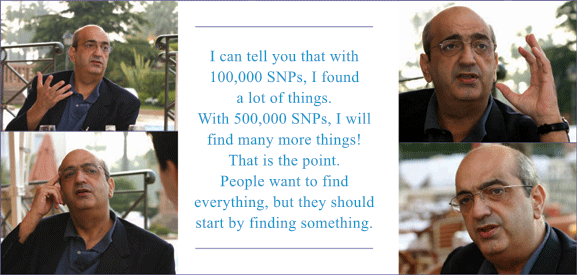
100,000 SNPs, we found 80 genes, and with 500,000 SNPs, we will find more genes, but this is not a problem. Let's say you find 200 genes, but these are not 200 independent problems, you can organize them into five to 10 pathways. It's not that complex. Yap: What was magical about 100,000 SNPs? Cohen: With this level of SNPs, you don't need to make any prior assumptions and hypotheses about associations. You start from scratch that is the most important thing. When you use other methods, you make a hypothesis and you look in one place for association. Sometimes there will be one gene, sometimes two, in the same region. Sometime there will be five genes, sometimes no gene at all. The magic of whole-genome scans is that you can look at the whole genome for all the genes—you don't need to know exactly where to look. It was a shock when Affymetrix announced that it would provide 100,000 SNPs. We had calculated we would need at least a few million genotypes over 10 years and with this we could now do 200 million— a factor of 100 more. We could do two logs more within one year! Yap: How many samples do you need to do this type of study? Are you saying that 900 cases and 900 controls were enough to look at MS in general, but not enough to study all the different subtypes of the disease? Cohen: This is a good question. There are a number of genes to be found in these studies, and some have a strong effect and then there is a continuum of others with weaker effects. Your sample size gives you the threshold: the larger the effect you are looking for, the smaller the sample size you need. But weaker effects are also very important and you need more samples to find those. If you ask me what size sample to use for any experiment, I don't know. The more you do, the more you find, it is that simple. Yap: In terms of number of SNPs, how do you see the value of 500,000 SNPs versus the 100,000 you are already using? Cohen: There is a debate as to whether you want to use more and more random SNPs, which is basically what we do, or whether we need to use carefully selected SNPs. I would put this a different way: my idea 10 years ago was to use 50,000 selected SNPs, very frequent SNPs that are well distributed at one every 50 to 60 kb, but my point then and now, is not to find all genes, but to find what I can, enough to assemble the pathways and find drug targets. With 50,000 SNPs using haplotype analysis you can find some genes. If you use random SNPs, you probably need more SNPs, and I have found that 100,000 SNPs corresponds with 30 to 50 percent genome coverage in our scans. That's the point that people don't understand: the more you add, the better. But you can already find genes today, and you can also keep adding SNPs. How important is being complete? What Lon Cardon [from Wellcome Trust Center of Human Genetics in Oxford] says is very true: we don't know how many SNPs you need for a complete scan. Is 10 million enough? We don't know. But I can tell you that with 100,000 SNPs, I found a lot of things! With 500,000 SNPs, I will find many more things! That is the point. People want to find everything, but they should start by finding something. Yap: [laughs] That is a very pragmatic approach! Cohen: This is why we wanted to get started with 100K and we found many things! FOR MORE INFORMATION | Contact Information
![]() Daniel Cohen, M.D., Ph.D.
Serono Genetics Institute S.A.
Vice-President, Worldwide Head of Genetics
Serono Genetics Institute
Route Nationale 7
91030 Evry Cedex, France
Phone : +33 1 60 79 66 66
Fax : +33 1 60 79 66 40
![]() Greg Yap
Affymetrix Inc.
Vice President of DNA Products
3380 Central Expressway
Santa Clara, CA 95051
Phone: 408-731-5000
[email protected] | Companies
![]() Serono Genetics Institute S.A.
![]() Affymetrix Inc. Conferences:
![]() Serono Symposia International's “Genetics of Autoimmune Diseases” Further Reading
![]() Cheng J, Kapranov P, Drenkow J, Dike S, Brubaker S, Patel S, Long J, Stern D, Tammana H, Helt G and others. Transcriptional Maps of 10 Human Chromosomes at 5-Nucleotide Resolution. Science 2005.
![]() Kapranov P, Cawley SE, Drenkow J, Bekiranov S, Strausberg RL, Fodor SP, Gingeras TR. Large-scale transcriptional activity in chromosomes 21 and 22. Science 2002;296(5569):916-9. | People
![]() Lon R. Cardon, Ph.D. Professor of Bioinformatics at Wellcome Trust Center of Human Genetics ![]() Thomas Gingeras, Ph.D. Vice President for Biological Research at Affymetrix
Background
![]() Serono Symposia International Learning Center on Multiple Sclerosis |
|

