Dutch Hospital Offers Heavy Dose of Translational Medicine
by Tommy Broudy
Erasmus Medical Center scientists Prof. Peter van der Spek and Prof. John Foekens weigh in on their institution's evolving infrastructure to support translational medicine From Pasteur to Salk, the purpose of biomedical research has always been to take research and turn it into a new diagnostic or treatment that improves health. Translational medicine aims to speed that process up by taking advantage of modern technologies and performing the primary research in such a way that it can be more quickly converted into an applied tool. While translational medicine is a phrase that baffles a lot of people, they would clearly support its benefits of cheaper and more effective healthcare. Erasmus Medical Center (MC) scientists John Foekens and Peter van der Spek have been working in the field for more than 20 years and to them translational medicine means an institutional commitment to a cross-functional infrastructure, a heavy dose of multidisciplinary teamwork, an unbiased approach to genome exploration, and developing alliances early with business partners that can help develop a diagnostic or therapeutic for the marketplace. “The bioinformatics team really ranges from IT [information technology] folks to molecular biologists to clinicians to statisticians. It's a variety of people,” said van der Spek. “But the multi-disciplinary angle of how the team works makes it possible to cross borders and perform research that we wouldn't otherwise be able to do.” Dr. van der Spek is a professor of bioinformatics, who uses modern genomic and proteomic approaches to study cancer predisposition genes and neuroscience relevant pathways at the molecular level. Dr. John Foekens is a biochemist who has published more than 200 articles focusing on breast cancer prognosis and therapeutics. Two recent studies he's been involved in have discovered expression signatures predictive of tamoxifen-resistant breast cancer and metastatic breast cancer; the studies were reported in the Journal of Clinical Oncology and The Lancet, respectively. The Erasmus MC scientists spoke with AMB Managing Editor Tommy Broudy about some of the challenges of setting up a translational medicine institute and some of the successes that have resulted. Setting up a translational medicine hospital
Broudy: Erasmus MC is now positioned as an incredible site for clinical trials using technologies like microarrays. How did you transition a traditional hospital to a clinical center for translational medicine like the one you have now? 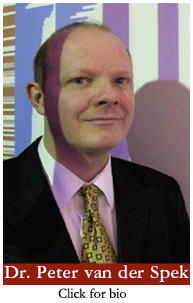 van der Spek: We have set up the bioinformatics department in such a way that it can also be used as a certified environment for supporting clinical trials and multi-center efforts. The bioinformatics department requires substantial hardware to look at complex volumes of data, as do the medical imaging and molecular imaging departments—two new areas that are expanding very rapidly. We have managed to combine the hardware for the molecular array data, proteomics data, and imaging data. We are seeing more and more biomarkers being discovered in projects, and of course, we can monitor these biomarkers in 3-D scans. In fact, we have built a 3-D cinema for the purpose of moving molecular biology towards medical imaging, a field now called molecular imaging.
Foekens: We are already working with Peter's bioinformatics group on a couple of new projects. For the breast cancer study that was just published in our Lancet paper, all the data-mining and bioinformatics were done by the group of Dr. Yixin Wang and Dr. David Atkins, Veridex LLC, a Johnson & Johnson Company, San Diego/New Jersey. We started the collaboration at the end of 2002 to help bring this signature to the clinic. By that time, Peter was at Johnson & Johnson and linked David onto the well documented patient archive in Rotterdam. Broudy: Translational research accelerates the process of bringing research from bench to bedside, but the work that goes on in each area typically has very different regulatory and quality control criteria. How can one institution really accommodate both? van der Spek: In terms of working with patient material for doing diagnostic classifications, there are actually three labs equipped with Affymetrix equipment in order to fulfill the regulatory restrictions. One lab is focusing on DNA SNP [single nucleotide polymorphism] profiling for linkage and cytogenetics purpose. Then we have a lab which focuses on the human RNA profiling for pathway analysis, and we have a third lab for animal models—the biomics core facility. Certification of the Affymetrix system last year was a major step forward in order to tie these things more immediately into our efforts in the clinic. That's because when you work with a certified machine and certified software, there won't be any more changes in the system. When you change the software halfway through the procedure, you cannot correlate things back to the samples that you had run previously. So that's what we also keep very strongly in mind. But in case changes are made somewhere in the analysis pipeline, we basically store the CEL, as well as the DAT files, so that we can go back to the raw data and push everything through the pipeline again completely once new ways of normalization or data mining get established. Foekens: We have separate labs to isolate RNA and DNA in the facility that our group uses. It's just isolation in these rooms because you need to, of course, control for contamination of aerosols. And then we take the RNA or DNA back to our lab for qPCRs [quantitative poly-merase chain reactions] or we take it to the central facility lab for microarray hybridization. Multi-disciplinary approach
Broudy: It wasn't too long ago that you really couldn't find two people with less in common than a statistician and a physician. How are you and the Erasmus research teams integrating informatics and statistics with the clinical team? van der Spek: We have set up a multi-disciplinary team that includes experts on IT, software, and on how to use these pieces of software, experts on genomics technologies and proteomics technologies, and statistics. And to tie all this together, we defined a five-pillar approach: 1. The first pillar is based on IT. So we focused two people on the computers that everything runs on. 2. Part two is the software which runs on the hardware. These are generally client-server applications. But the software needs adjustments, so we have a pillar called, ‘Software Development.’ There, we optimize certain ways of viewing the data. For instance, with the leukemia study of Valk et al. published in the New England Journal of Medicine in 2004, we made a picture where we combined clinical data with the molecular data coming off the arrays. The first picture was born by analyzing one correlation view with large volumes of patients. So if we've already compared 300 patients, and number 301 walks into the clinic, we can immediately position that individual into the history of all the patients that we have previously seen on the arrays. For the diagnostic decision-making process, that's part one, a clinician wants to see where the patient falls out. 3. Now, of course, we have a pillar which focuses on education. This is because we are a university. Moreover we need to train people in using visualization and data-mining solutions. We realized that we needed to create certain views that clinicians and biologists could see via a web environment, because almost all clinicians are nowadays used to working with Internet Explorer or with their email. When we did that, the learning curve went down enormously, because then we didn't have to train them as much and could actually go for end results. 4. Another pillar covers our genomics group. All the array profiling expertise is in there. 5. And finally, we have a pillar which focuses on mass spectrometry and other proteomic approaches. And, as mentioned, the five pillars are loaded with a variety of multi-disciplinary people. We have a nuclear physicist in our proteomics pillar that is not afraid to deal with the vast, vast volumes of data that are generated in pro-teomic experiments. Foekens: In my own group, together with Professor Jan Klijn (he's the medical oncologist we work with), we also recognized the importance of this multi-discipli-nary approach. Our group is about 20 people, and we have a biostatistician, together with a medical doctor, molecular biologists, and technicians specializing in pathology, biochemistry, and molecular biology. We also have two people who specialize in animal studies. Just look at our prognosis or response to therapy studies. We have information coming from DNA methylation, from RT-PCR [real-time reverse-transcriptase poly-merase chain reaction], from the microar-rays, and now it's coming from proteomics. It's all different, and we need a team that can combine it. Whole genome vs. focused study
Broudy: The benefits of whole-genome exploration in the discovery phase of translational research seem clear. What are your thoughts about whole genome vs. focused analysis when the data coming off these high-density technologies make their way to the actual patient?  Foekens: For the whole genome, you need frozen tissue. But it's always preferable to do the whole-genome analysis, because you can always come back later to ask new questions and to find new profiles. The breast cancer study which we have done with Veridex is a good example. We found the profile and validated it in our own patient set—that's the Lancet paper. But now we have to move on to bring it to the clinic, so what we need is an independent validation set, and preferably a prospective trial.
But before you can enter a prospective trial, you need to validate the data. So we have performed a multi-center study with several institutes in Europe. For this validation study, we are working with Veridex and they have a custom Affymetrix microarray with the 76 genes on it. The whole-genome approach may be preferable, but in practice it seems that a dedicated chip is more pragmatic. The whole-genome chip allows you to do discovery studies, but you also get your problem of intellectual property-related issues where everybody wants a piece of the cake, so it gets very complicated. We may bring our 76-gene breast cancer signature down to a multiple-qPCR. In the end, it may be a diagnostic chip. I'm just not sure yet. van der Spek: In my eyes, whole-genome analysis is easier also with respect to the statistics of doing the analysis. The genes which don't change also tell you a lot in terms of the stability of the experiments. And a full-genome chip allows you to measure and study pathways which you initially would not study in the context of the disease. With the hematological type of questions, you could be studying leukemia, but the analysis may give you added information about everything from blood group to high cholesterol levels. You can measure so many more things, which you can't do when you have a theme. And in order to gain insight into the underlying molecular pathways involved in cancer we use the Ingenuity pathway database. Developing better signatures
Broudy: John, you have a lot of experience with multi-centered studies. What are your thoughts about maintaining data quality with so many groups involved? Foekens: I don't think location of the participating institutions is a major concern. If you set pre-defined criteria for the inclusion of patients in your studies before analyzing any RNA on the microarray, you should be okay. We have now performed multi-center studies where the centers sent tissues to our institute and we isolated the RNA. The quality is perfect. There's hardly any drop-out because of poor quality. It would be different, of course, if you asked the separate small institutions to isolate the RNA themselves. We know from the early days in the quality control rounds organized by Professor Theo Benraad, and nowadays by Professor Fred Sweep in Nijmegen, that the variability for something like a protein assay can be over 20 to 30 percent. That does not mean that the specific laboratory is performing badly; it's just that everybody uses his own standard to calculate something like the protein content or the estrogen-receptor or progesterone-receptor level. There can be a difference of a factor of 10 between two laboratories, while their intra-laboratory variation is extremely low. So it's just a matter of standardization. Developing diagnostics and impacting healthcare
Broudy: Your recent work in the Lancet has identified a very strong signature predictive of breast cancer metastases. What strategies are you using to move this into an actual diagnostic? Foekens: In the Lancet paper we validated our profile in an independent set of 171 patients. But to bring it to the clinic, you need more. First of all, you need a company, because as a research group you cannot bring something to the clinic. We are now validating the profile in two multi-center patient cohorts. One is an untreated set of 180 patients. That data has already been analyzed and the data look excellent. We are now analyzing a cohort of lymph-node negative breast cancer patients treated with tamoxifen, so that will be a second independent validation. We're still working up samples, isolating RNA and sending it to Veridex for microarray analysis. We'll need at least 200 samples in this second set because there are fewer failures, fewer relapses, in tamoxifen-treated patients compared with the untreated. Then, we would like to go, of course, into prospective clinical trials, but that's for the business people at Veridex (Johnson & Johnson) to decide. We generated the profile together with Veridex and they wish to bring it to the clinic if the validation studies hold like they do now. In the first multi-center validation study, it looks excellent. Broudy: Integrating expression data and clinical data along with other molecular data will be key. How do the software packages that you're developing now work towards this very large goal of integration? van der Spek: That's a very important point. If you have programmers that build particular solutions, these solutions have to be supported over time. The aim of a medical center is not to support software, so you need to build software in collaboration with professional players in this field. We can build very fancy new ways of looking at and analyzing data, but we do it in collaboration with preferred software partners like Spotfire and OmniViz . They can take over the routines, support them over time and migrate them into new versions. We could never do this from a medical center. Also, pharmas are now interested in using web based tools, such as Inxight technology to couple microarray data onto the latest version of the human genome, which has the most current annotation, and link all their historical experiments onto the newer annotation files. Of course, you can do this via the NetAFFX web site, but that's still quite labor intensive, and you don't want your scientists to have to worry whether they are working with the latest annotation. You just want to have it there. We are working on these kinds of solutions with EBI, the European Bioinformatics Institute in Cambridge, UK. FOR MORE INFORMATION | Contact Information
![]() Peter van der Spek , PhD
Department of Bioinformatics
Erasmus MC
EE 15-40
P.O. Box 1738
3000 DR Rotterdam
Netherlands ![]() John A. Foekens, PhD
Department of Medical Oncology Josephine Nefkens Institute
Erasmus MC
Dr. Molewaterplein 50
3015 GE Rotterdam
Netherlands
Companies
![]() Affymetrix Inc.
![]() Johnson & Johnson Inc.
![]() Veridex LLC | Organizations:
![]() Erasmus MC
![]() European Bioinformatics Institute
![]() National Center for Biotechnology Information Further Reading
![]() Wang Y, Klijn JGM, Zhang Y, Sieuwerts AM, Look MP, Yang F, Talantov D, Timmermans M, Meijer-van Gelder ME, Yu J, Jatkoe T, Berns EMJJ, Atkins D, Foekens JA. Gene expression profiles to predict distant metastasis of early breast cancer. Lancet 2005; 365(9460):671-9.
![]() Jansen MP, Foekens JA, van Staveren IL, Dirkzwager-Kiel MM, Ritstier K, Look MP, Meijer-van Gelder ME, Sieuwerts AM, Portengen H, Dorssers LC, Klijn JG, Berns EM. Molecular classification of tamoxifen-resistant breast carcinomas by gene expression profiling. J Clin Oncol 2005; 23(4):732-40.
| ![]() Van der Spek PJ, Kremer A, Murry L, Walker MG. Are gene expression microarray analyses reliable? A review of studies of retinoic acid responsive genes. Genomics, Proteomics & Bioinformatics 2003; 1(1):9-14.
![]() Valk PJ, Verhaak RG, Beijen MA, Erpelinck CA, [Barjesteh van Waalwijk van Doorn-Khosrovani S], Boer JM, Beverloo HB, Moorhouse MJ, van der Spek PJ, Lowenberg B, Delwel R. Prognostically useful gene-expression profiles in acute myeloid leukemia. N Engl J Med 2004; 350(16):1617-28.
Tools for download
![]() OmniViz
![]() Spotfire
![]() Ingenuity
![]() Inxight |
|



